

18 Nov My Child’s Walking Looks Different: Common Gait Patterns Explained
Early walking often looks unsteady, wide and different from an adult’s gait. Toddlers are learning to control a small body with a relatively large head, and they use strategies that create stability while their strength and balance develop. Variation is expected.
A wide-based, short-stepping walk
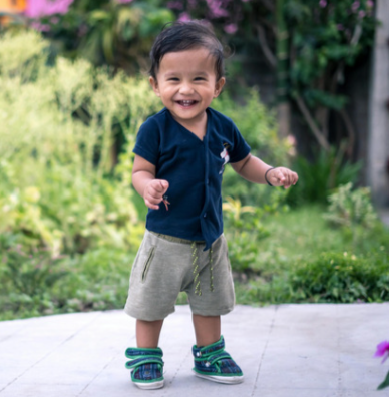
New walkers commonly keep their feet farther apart, take short steps and hold their arms high to give them a more stable base for balance. They may sway, stop often and fall as they experiment. With practice, and as strength and balance improve, the base usually narrows, steps become smoother with more swing forward of the leg and the arms begin to swing.
Falls are part of learning. Uneven surfaces, rushed movement, tiredness, carrying objects, obstacles and being distracted can make it more difficult. Assessment is useful if progress with adequate practice isn’t seen.
Feet turning in (in-toeing)
In-toeing can arise from the foot, shin or hip and is common in childhood. It often improves naturally with growth and strengthening. Special shoes and braces are not routinely recommended for typical developmental in-toeing. Assessment is useful when it is painful, rigid, strongly one-sided, worsening or limiting play, or if you are concerned.
Walking on tiptoes (toe walking)
Occasional toe walking can occur when a child is learning to walk or excited. Persistent toe walking, particularly if your child cannot place the heels down, one side is different, the calf/ankle feels tight, there is pain, or there are concerns in other areas of development, requires review.
Toe walking can have several explanations. We can assess joint range, strength, balance, sensation, movement patterns and development before suggesting if management is required.
Flat-looking feet and turned-out feet
Young children often have a visible fat pad through the arch and flexible feet that look flat when standing. Many develop a clearer arch with growth and age. Feet may also point outward for balance, especially early in walking.
Seek assessment when there is persistent pain, stiffness, skin pressure, repeated ankle giving-way or rolling in, a marked one-sided difference or difficulty participating.
Knock knees and bowed legs
Leg alignment changes with growth. Babies and young toddlers may look bow-legged, while knock knees are common later in early childhood. Many patterns fall within expected developmental variation. An assessment is recommended when alignment is severe, one-sided, painful, or worsening.
When should we book an assessment?
Book a paediatric physio assessment if your child is not achieving independent gait, walking is not progressing, patterns observed are worsening, they have a limp or pain, falls are unusually frequent, one side moves differently, the pattern limits play, skills have plateaued, or you simply remain concerned about any of the above patterns.
Most early walking quirks settle as balance, strength and coordination mature. An assessment can help explain what you are seeing, whether support is needed and how you can help if required.
Book online or call us on (03) 8001 2042.
When to seek urgent medical care
Seek urgent medical care if your child suddenly refuses or cannot bear weight, has severe pain, fever with a limp, a hot or swollen joint, a significant injury, or appears acutely unwell. Loss of previously acquired movement skills also needs prompt medical assessment.
Sorry, the comment form is closed at this time.